Summary
In April 2020, as COVID-19 overwhelmed Elmhurst Hospital in Queens, New York, reporters dubbed it “the epicenter of the epicenter” of the pandemic. Few noted that this was not the first time the institution had borne such a burden. A century earlier, its predecessor—City Hospital on Welfare Island—faced similar devastation during the 1918 influenza pandemic. Though physically separated by geography and time, both hospitals shared a mandate to care for marginalized communities, rendering them vulnerable to repeated cycles of crisis.
Institutional Lineage
City Hospital (1832–1957): A Relic of Neglect
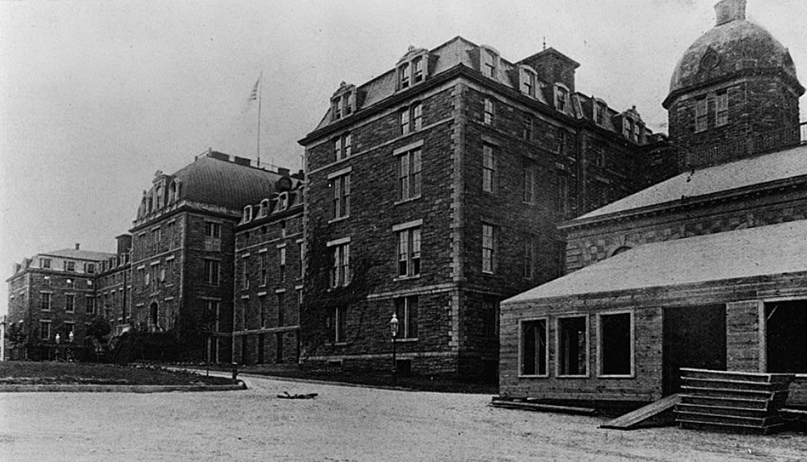
Established in 1832 on Blackwell’s Island (renamed Welfare Island in 1921 and Roosevelt Island in 1973), City Hospital was New York’s primary public hospital for the poor. Designed as an almshouse and tuberculosis sanatorium, it operated under conditions described by reformer Jacob Riis in 1890 as “a disgrace to civilization.” By 1918, the hospital’s crumbling wards housed over 2,000 patients, many of them immigrants from Queens, Brooklyn and Lower Manhattan unable to afford private care.
Elmhurst Hospital (1957–Present)
In 1957, amid postwar urbanization, the city relocated the institution to Queens and renamed it Elmhurst General Hospital. The move aimed to modernize facilities but did little to alter its core demographic: Queens’ working-class immigrants. As one 1960 New York Times article noted, “The patients at Elmhurst are the same as those at Welfare Island—only their languages have changed.”
The 1918 Influenza Pandemic
Overcrowding and Collapse
When influenza struck New York in September 1918, City Hospital’s Welfare Island campus became a triage zone for Queens’ immigrant communities. The hospital, already strained by tuberculosis cases, lacked isolation wards or ventilators. Nurse accounts describe hallways lined with patients “gasping like fish on a dock,” while death certificates reveal that 72% of the dead were Italian, Polish, or Irish immigrants.

Class divisions exacerbated the crisis. Wealthier Manhattanites fled to private clinics or country estates, while Queens’ factory workers—deemed essential to the wartime economy—faced impossible choices between employment and safety. A November 1918 report by the New York City Department of Health admitted that Welfare Island’s hospital received “only 15% of the city’s medical supplies, despite handling 30% of its critical cases.”
Public discourse largely blamed immigrants for the pandemic. Queens’ newspapers targeted Italian communities, with the Long Island Daily Star claiming on October 20, 1918, that “their crowded tenements breed disease.”
COVID-19 and Elmhurst Hospital
A New Pandemic, an Old Playbook

In March 2020, Elmhurst Hospital again became a symbol of systemic failure. Queens, home to 2.4 million immigrants from 150 countries, suffered New York’s highest COVID-19 mortality rate. The hospital’s ICU reached 200% capacity, with refrigerated morgue trucks parked outside—a scene eerily reminiscent of 1918’s laundry-room body stacks.
As in 1918, class and citizenship shaped outcomes. Undocumented immigrants avoided testing out of fear, while frontline workers (many employed in Queens’ airports and food industries) lacked paid sick leave. Dr. Mitchell Katz, CEO of NYC Health + Hospitals, acknowledged in 2020 that “Elmhurst’s patients are the ones everyone else forgot—just like in 1918.”
Parallel Failures
Both pandemics exposed decades of underinvestment. In 1918, City Hospital’s annual budget was $200,000 3.6 million today), compared to $1.2 21.8 million today) for Manhattan’s private Lenox Hill Hospital. In 2020, Elmhurst operated on $800 million annually—half the budget of Manhattan’s NYU Langone, despite serving triple the patient volume.
The Unbroken Mission: Serving the Marginalized
Immigrant communities have anchored the hospital’s patient base for over a century:
- 1918: Italian, Irish, and Eastern European factory workers.
- 2020: South Asian, Latin American, and East Asian essential workers.
In both eras, limited English proficiency and lack of insurance compounded health disparities. A 1920 report by the Charity Organization Society found that 60% of Welfare Island patients spoke no English; in 2020, 48% of Elmhurst patients required interpreters.
Mutual aid bridged institutional gaps. In 1918, Queens’ Italian societies distributed homemade remedies; in 2020, Bengali grocery owners delivered food to quarantined neighbors. Yet, as historian Nancy Bristow notes, “Such efforts reflect community strength—not systemic adequacy.”
Elmhurst Hospital’s dual crises reveal a pattern of “structural triage,” wherein marginalized communities bear disproportionate risks due to policy choices.
Bibliography
-
- Annual Report of the Department of Health of the City of New York for 1918. NYC Municipal Archives.
- Death Certificates, Queens County, 1918–1919. Municipal Archives of New York City.
- “Influenza Overwhelms City Hospital.” Long Island Daily Star, October 12, 1918.
- Riis, Jacob. How the Other Half Lives. New York: Scribner’s, 1890.
- NYC Health + Hospitals. 2020 Annual Report: Elmhurst Hospital.
[FEATURED IMAGE: City Hospital, Welfare Island, courtesy of Library of Congress.]

Eric is a 4th-generation native New Yorker and a professional historian, author and educator.