Queens Boulevard, often grimly referred to as the “Boulevard of Death” due to its historically high accident rate, stands today as one of New York City’s most iconic and impactful roadways. Stretching over seven miles from the Queensboro Bridge to Jamaica, its story is one of transformation, urban planning, and its profound effect on the surrounding communities, particularly Elmhurst, Woodside, and Rego Park.
Early History: Origins of the Boulevard
The roots of Queens Boulevard trace back to the late 19th century when it was a dirt path connecting Long Island City to the rural heart of Queens County. Originally named Hoffman Boulevard after John Thompson Hoffman (1828–1888), the street honored the former Mayor of New York City (1866–1868) and Governor of New York (1869–1873). Hoffman was a prominent political figure known for his influence during a transformative period in the city’s history. By 1916, the road was renamed Queens Boulevard to better reflect its significance as a major thoroughfare in the borough.
In 1909, the 59th Street/Queensboro Bridge (does anybody actually call it the Ed Koch Queensboro Bridge?) was completed, providing a direct connection between Queens and Manhattan. This infrastructure development catalyzed the expansion of Hoffman Boulevard, as city planners sought to create a grand artery to accommodate increased traffic. By the 1910s, the decision to widen and pave the road was made, marking the first phase of its transformation.
The Vision and Planning: 1920s to 1930s
The 1920s saw rapid urbanization in Queens, fueled by the advent of the subway system. The Independent Subway System (IND) extended into Queens in 1933, running beneath Queens Boulevard and further necessitating its expansion. The road was officially renamed Queens Boulevard in the 1920s to reflect its prominence.
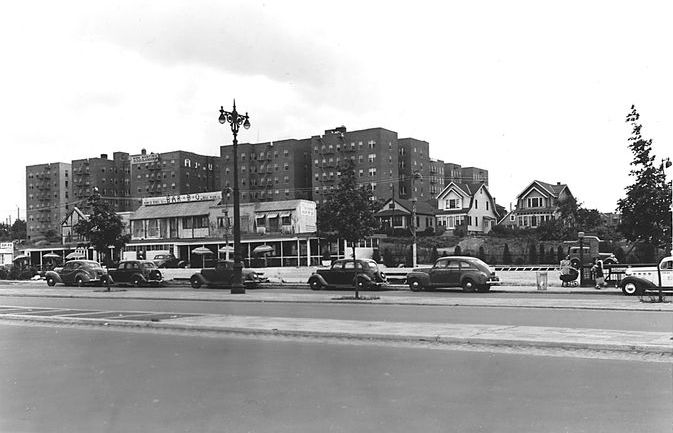
City planner Robert Moses played a significant role in the boulevard’s development during this period. Under Moses’ leadership, the New York City Department of Parks and the Triborough Bridge and Tunnel Authority oversaw the boulevard’s transformation into a multi-lane roadway designed to accommodate automobiles, buses, and pedestrians. By the mid-1930s, Queens Boulevard featured a wide central roadway flanked by service roads, making it one of the largest thoroughfares in the city.
Expansion and Impact on Communities
The widening and extension of Queens Boulevard had significant ramifications for the communities it traversed. Elmhurst, once a sleepy village known as Newtown, experienced a population boom as developers built apartment complexes and commercial spaces along the boulevard. By the 1940s, Elmhurst was blossoming into a bustling urban neighborhood, with Queens Boulevard serving as its lifeline.
Similarly, Rego Park emerged in the 1920s and 1930s as a planned residential community. The Real Good Construction Company, which gave the neighborhood its name, developed rows of Tudor-style homes and apartment buildings. Queens Boulevard’s expansion facilitated Rego Park’s growth by improving access to transportation and commerce. The construction of the Rego Park Center in the late 20th century further solidified the area as a retail, residential and commercial hub.
Woodside, historically an Irish immigrant enclave, also underwent significant changes due to the boulevard’s development. As transportation improved and housing became denser, the neighborhood became a melting pot of cultures, attracting residents from Latin America, South Asia, and beyond.
Post-War Development and Challenges
The post-World War II era saw Queens Boulevard become a symbol of modernity and mobility. However, its design also presented challenges. The road’s sheer width—up to 12 lanes in some sections—made it perilous for pedestrians. By the 1990s, Queens Boulevard had earned its infamous nickname, with about a dozen pedestrian fatalities occurring annually.
Revitalization Efforts: 2000s to Present
In response to public outcry, the New York City Department of Transportation (NYC DOT) initiated a series of safety improvements beginning in the early 2000s. These included the installation of pedestrian islands, countdown signals, and dedicated bike lanes. Under Mayor Bill de Blasio’s Vision Zero initiative, launched in 2014, the boulevard underwent further redesigns to reduce traffic fatalities. By the late 2010s, pedestrian fatalities had dropped nearly zero. “The Boulevard of Death has become the Boulevard of Life,” said Mayor Bill de Blasio in a 2017 interview.
As Queens continues to grow, Queens Boulevard remains a vital artery, embodying the borough’s dynamic and ever-changing spirit.
Featured image courtesy of the NYPL digital collection.

Eric is a 4th-generation native New Yorker and a professional historian, author and educator.