Summary
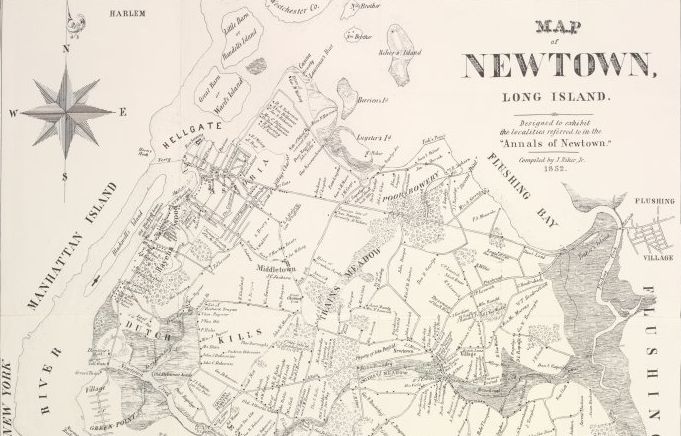
James Riker’s "The Annals of Newtown, in Queens County, New York" (1852) provides an in-depth historical account of the area now known as Elmhurst, Queens. Covering its transformation from First Nations land to a colonial settlement and eventually a growing urban center, Riker’s work remains an invaluable resource for understanding the foundations of modern-day Queens. Below is a detailed chapter-by-chapter summary with as many names, dates, and modern locations as possible.
Chapter I: Mespat Colony (1609–1650)
By the 1630s, Dutch settlers had begun to establish trading posts throughout present-day Queens. In 1642, Reverend Francis Doughty led a group of English Puritan settlers from Massachusetts to found Mespat, near present-day Maspeth. The settlement was located near the headwaters of Maspeth Creek, around present-day Rust Street and Grand Avenue. However, conflicts with the local Matinecock tribe, part of the larger Lenape nation, led to the settlement’s destruction during Kieft’s War (1643–1645). By 1650, Dutch forces had regained control of the area, but Mespat was largely abandoned.
Further expansion of trade and interaction with Native peoples was necessary for the Dutch to solidify their presence. The Dutch constructed small outposts along the Newtown Creek and Flushing Bay, setting up ferry points that evolved into essential commercial hubs in later centuries. The proximity to the East River also ensured access to Manhattan, which, even in the early colonial era, was the region’s economic focal point.
Chapter II: Founding of Middelburg (1652–1664)
In 1652, English settlers from New England, led by Richard Betts, John Coe, and Thomas Hazard, established a new village further inland to avoid conflict. The settlement, initially called Middelburg, was strategically located at what is now the intersection of Queens Boulevard and Broadway. By 1656, a grid of home lots had been surveyed, with each settler receiving designated land parcels.
Middelburg’s early structures included simple wood-framed homes and a small meeting house, which was located near present-day Elmhurst Avenue and 45th Avenue. The meeting house served multiple purposes, including religious services and town meetings, reinforcing the town’s Puritan roots. As the population grew, roads were laid that connected the village to the settlements in Flushing and Jamaica, which are today’s Roosevelt Avenue and Jamaica Avenue, respectively.
The community quickly grew, relying on farming and trade with New Amsterdam (modern-day Lower Manhattan). However, tensions between English settlers and Dutch authorities persisted. In 1664, the English seized control of New Netherland, renaming it New York. Middelburg was renamed Newtown to distinguish it from the earlier failed Dutch settlement at Maspeth.
Chapter III: Development and Challenges (1664–1685)
Under English rule, Newtown expanded significantly. The first roads were laid, following paths used by the Matinecock. Modern-day Woodside Avenue and Grand Avenue trace their origins to these early colonial roads. In 1668, the town established its first gristmill near Newtown Creek to support local agriculture.
Boundary disputes emerged between Newtown and neighboring Bushwick, which was still predominantly Dutch. In 1670, Governor Francis Lovelace intervened, solidifying the town’s eastern boundary near present-day 48th Street.
The late 1600s saw the emergence of larger agricultural estates, with families such as the Rikers and Lawrences owning expansive farmland. The Riker estate, which once covered much of present-day Jackson Heights and East Elmhurst, became a focal point of economic activity, with produce being sold at markets in Manhattan.
Chapter IV: Political and Social Growth (1686–1700)
Governor Thomas Dongan granted Newtown an official charter in 1686, defining its legal status and governance structure. This period saw the construction of the town’s first church, located near modern-day St. James Episcopal Church on Broadway and 51st Avenue.
The population increased, with new settlers arriving from England and the Netherlands. Notable families from this period included the Rikers, Lawrences, and Rapelyes. By 1699, the town had its own constable and town meetings, held at what is now “Elmhurst.”
During this period, the town saw the establishment of new schools, with early classes being held in homes before a dedicated schoolhouse was built near present-day Elmhurst Library. The local economy was still primarily agrarian, with families growing corn, wheat, and vegetables on land that stretched across today’s Woodhaven Boulevard and Grand Avenue.
Chapter V: Revolutionary War and Its Impact (1775–1783)
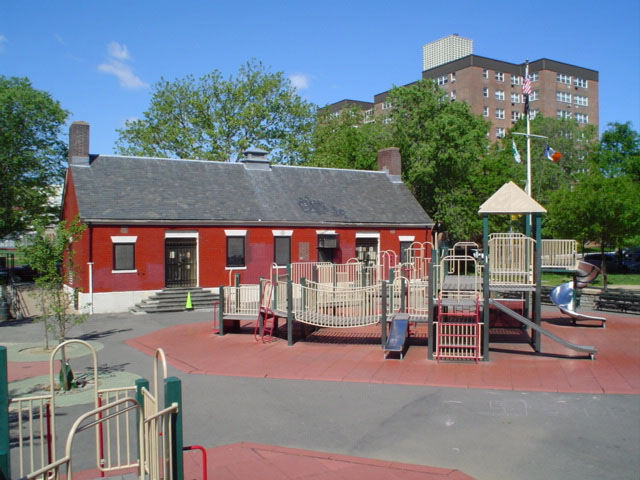
As tensions between the colonies and Britain escalated, Newtown became a hotbed of revolutionary activity. In April 1775, militia drills took place at what is now Newtown Playground on 92nd Street. Prominent revolutionaries from Newtown included Samuel Riker and Jonathan Lawrence, who actively participated in the war effort. The British occupied the town from 1776 to 1783, stationing troops in homes, churches, and taverns. The Onderdonk House, now a historical site in Ridgewood, served as a British headquarters during the war.
After the war, Loyalist families fled to Canada, while Newtown residents faced economic hardship due to the destruction left by occupying forces. Reconstruction efforts began in the 1780s, with local leaders focusing on rebuilding roads, homes, and farms.
Chapter VI: The 19th Century Transformation (1800–1850)
By the early 19th century, Newtown was transitioning from an agricultural economy to a more urbanized community. The construction of new roads and bridges improved transportation, connecting the town more directly to Manhattan. The development of stagecoach lines along Queens Boulevard facilitated commerce and trade, with goods moving between Brooklyn, Manhattan, and eastern Long Island.
New industries, including milling, blacksmithing, and shipbuilding, emerged in the area. In 1821, Newtown Academy was established near today’s Elmhurst Library, furthering the town’s reputation as an educational center. Population growth led to the expansion of housing developments, with wealthier families constructing larger homes along what is now 51st Avenue.
Chapter VII: Genealogical Records and Legacy
The latter portion of The Annals of Newtown provides detailed genealogies of prominent Newtown families, such as the:
- Rikers (Settled in 1660, estate near Riker’s Island)
- Lawrences (Active in politics and military affairs)
- Brinckerhoffs (Owned large farms in present-day Middle Village)
- Moores (Early developers of East Elmhurst and Jackson Heights)
These records offer insights into the families who shaped the town’s growth and whose names still appear on streets and landmarks throughout Queens.

Eric is a 4th-generation native New Yorker and a professional historian, author and educator.